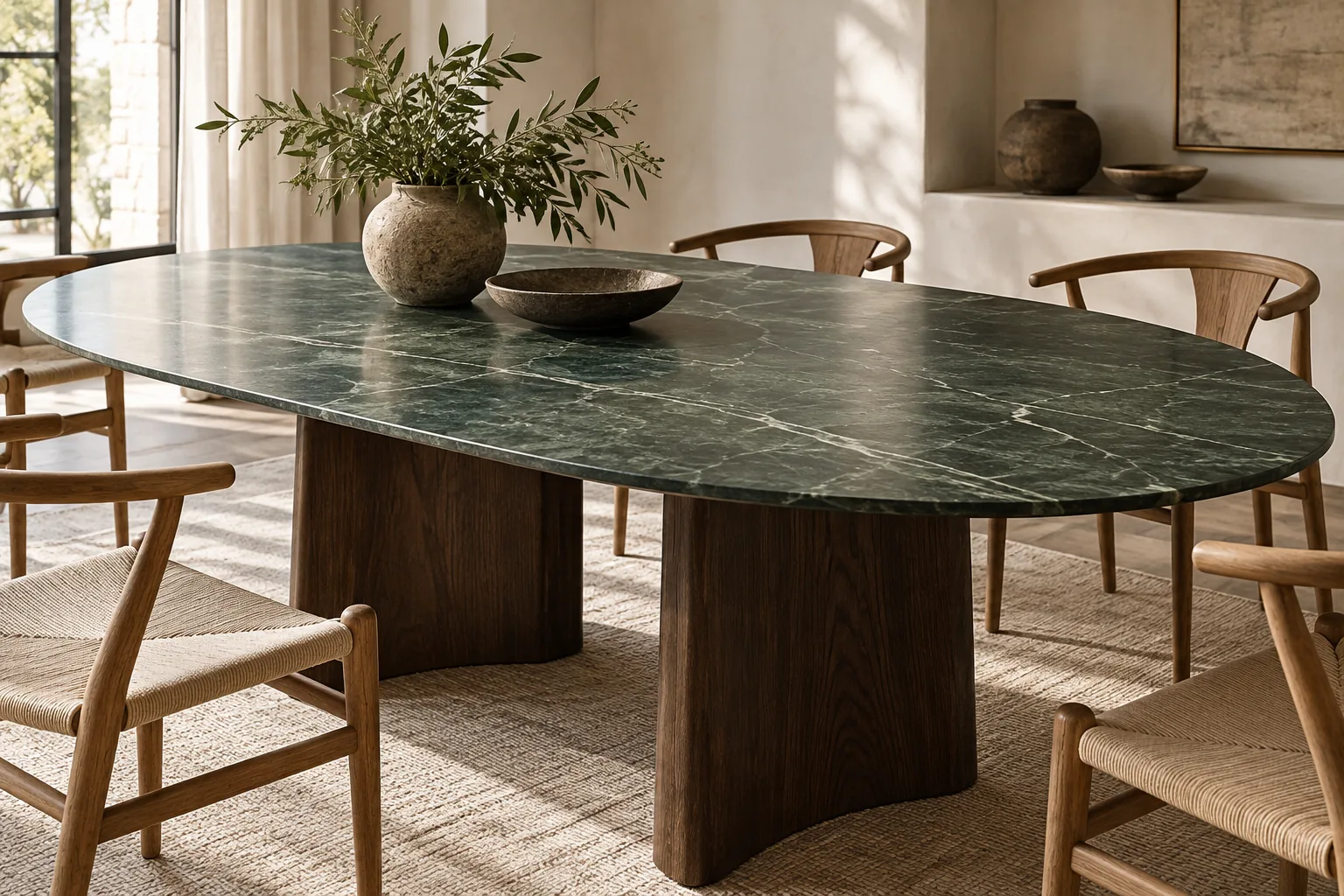
Dining tables, coffee tables and cabinet fronts turn a decorative slab into a repeatable manufactured component. Appearance, fit and protection must be resolved at the part level. A round top, an irregular coffee table and a long dining surface can share a material yet need different edge geometry, support and packing. Define the product family you intend to make and develop its drawings before treating a slab reference as a production-ready specification.
Finished shapes, holes and edge profilesBacking, hardware and support reviewPart labels and protective packaging
Illustrative interior · not a completed customer project
01 / Planning notes
Define the component
Supply finished dimensions, shape, edge details and hole locations on a drawing. Identify the visible side and distinguish a raw slab enquiry from a request for prepared components.
02 / Planning notes
Review the complete furniture assembly
The component needs to work with its frame, backing, fixings and intended loading. Have the furniture designer or fabricator confirm support and attachment details for the selected product.
03 / Planning notes
Organise repeat orders
Record the approved model and sample, drawing revision, tolerance requirements and packing arrangement. Part identification helps link the received items to the production schedule.
Design the tabletop as part of a complete furniture system
01
Create a drawing for every finished shape
AI-generated design illustration; not a supplied product or completed project.
An overall length and width do not fully define an oval, radius-corner rectangle or irregular top. Provide a dimensioned drawing or agreed digital outline with the datum, corner geometry and hole centres identified. State which dimensions are critical to the frame and which describe the outside appearance. Where several sizes share a design, give each its own part number and revision rather than relying on a scaled photograph. A checked first article can be used to confirm the agreed geometry and assembly fit before the same component is repeated in a larger furniture run.
Distinguish top-view dimensions from finished edge dimensions.
Label the visible face and any orientation-sensitive grain.
02
Coordinate the frame, attachment and underside
AI-generated design illustration; not a supplied product or completed project.
The furniture designer should review how the component is supported and attached, including any backing layer, intermediate pad or fixing plate. The positions of base rails and leg plates can affect the usable fixing area and the visible underside. Avoid assuming that holes can be drilled anywhere or that a decorative front can carry the same loads as a horizontal top. Any adhesive or mechanical connection needs to be selected for the actual assembly by the responsible professional. If the furniture is demountable, identify which connections will be made at the factory and which the customer will complete.
Show the support contact areas in an underside view.
Review attachment proposals before fixing holes are released.
03
Protect edges through the assembly journey
AI-generated design illustration; not a supplied product or completed project.
A finished tabletop is handled differently from a raw slab. Decide how corners, thin edges, polished faces and adjacent components will be separated inside the pack. If the furniture ships as a kit, identify each part so the assembly team can recognise the top, base and fittings without opening unrelated packages. Discuss the receiving method, lifting route and temporary storage with the buyer. Keep the approved first-article reference, drawing revision and packaging specification together so that a repeat production run does not quietly change a visible edge or a protective detail.
Use part IDs on packing labels and assembly references.
Approve protective details for the actual finished profile.
FURNITURE COMPONENT DEVELOPMENT
Furniture part definition
Furniture part definition
Element
Design decision
Information to provide
Shape
Corner geometry and critical dimensions
Dimensioned outline with datum
Edge
Profile, visible face and underside
Finished-edge section
Connection
Frame contact and attachment access
Base drawing and support zones
Production kit
Part identity and protective separation
Part list and packing layout
Sintered Stone Furniture Panels & Tabletops
Questions buyers ask
Is a sketch enough for an irregular tabletop?+
A sketch can start the discussion. Production needs an agreed, dimensioned geometry with a datum, edge section and any critical fitting dimensions.
Can the same fixing detail serve every table size?+
The furniture designer should check each size and support arrangement. Changing the span, top shape or leg position can change the assembly requirements.
What makes a repeat furniture order easier to control?+
Keep the accepted first article, part code, drawing revision, appearance sample and packing detail linked. That reference set is more precise than a previous invoice description alone.
LET’S START A CONVERSATION
Your next project
starts with a surface.
Tell us what you are sourcing. We will help turn your requirements into a clear product enquiry.